
What's the intent of the philosophy?
What is the most boring document you will read this year? It better not be our philosophy. It may seem pointless. Why spend months bothering to write something nobody will read? Our answer is this:
Our philosophy will be the guiding document for The Common Good Party. We can’t go to a Common Good manifesto written 200 years ago, so we have been writing our own. We are looking to set the bounds and direction of the Common Good party. Not just us setting the bounds but everyone contributing.
Consultation takes time, but it is needed. The more minds looking at our philosophy, the stronger it will be. We want to be using this document to build policy issues we couldn’t dream of in 20 years time.
Our party started around four key issues.
- Compassion for refugees
- Family and life issues
- Religious freedom
- Climate change
All are still important, but some are now less prominent. We now particularly see issues like inflation and the cost of housing affecting our common good.
Beyond everyday issues, we see a general frustration at politics. So short term and so tribal. Our philosophy will help us be a coherent party that can think long-term.
---
If you have engaged with our members you will quickly realise that we come from across the political spectrum. From the “far left” to the “far right” and everywhere in-between.
Our “Lefties” are passionate about social justice, but find some of the social policies of the ALP and particularly the Greens unpalatable.
Our “right wing” members tend to be traditional conservatives who are looking for a serious ethical alternative to vote for.
Our philosophy is trying to include both of these groups. This is at the heart of who we are and the party we are creating. We recognise that both the left and right speak clear truth and clear lies. We utterly reject the tribalism and dogmatic partisanship that plagues our politics.
We don’t seek to blend red and blue into some kind of dusty Dame Edna mauve hairwig.
No. Iron sharpens iron. The best policies come from robust debate, not groupthink. Political differences must remain within the party.
This philosophy aims to set the bounds of those differences and unite us behind a common flag as we work towards the common good.
This said, there are a few disclaimers.
- It is not professionally written. It is designed to serve its purpose rather than be brilliantly written or cover every possibility.
- It is not going to make everyone happy. Most will have some issues with it.
- It is not definitively setting the bounds of who is in or out of the party.
- It IS expected to be added to and improved in the future.
That said, the goals of it are as follows:
- To be a declaration of values of who we are as a party that others can confidently join for the next 20 years.
- To let us make consistent policy decisions and moral judgements.
- To use clear language attractive to both left wing and right wing members.
- To protect the party’s values from rapid growth and changing leadership.
If you have read through here, then the journey is just starting. Please read through our draft philosophy here and make comments. We will be releasing it in more manageable chunks over the next few months, but it is best read in its entirety.
Now is the time to join in and help set the direction for our party for the next fifty years.
The Plan
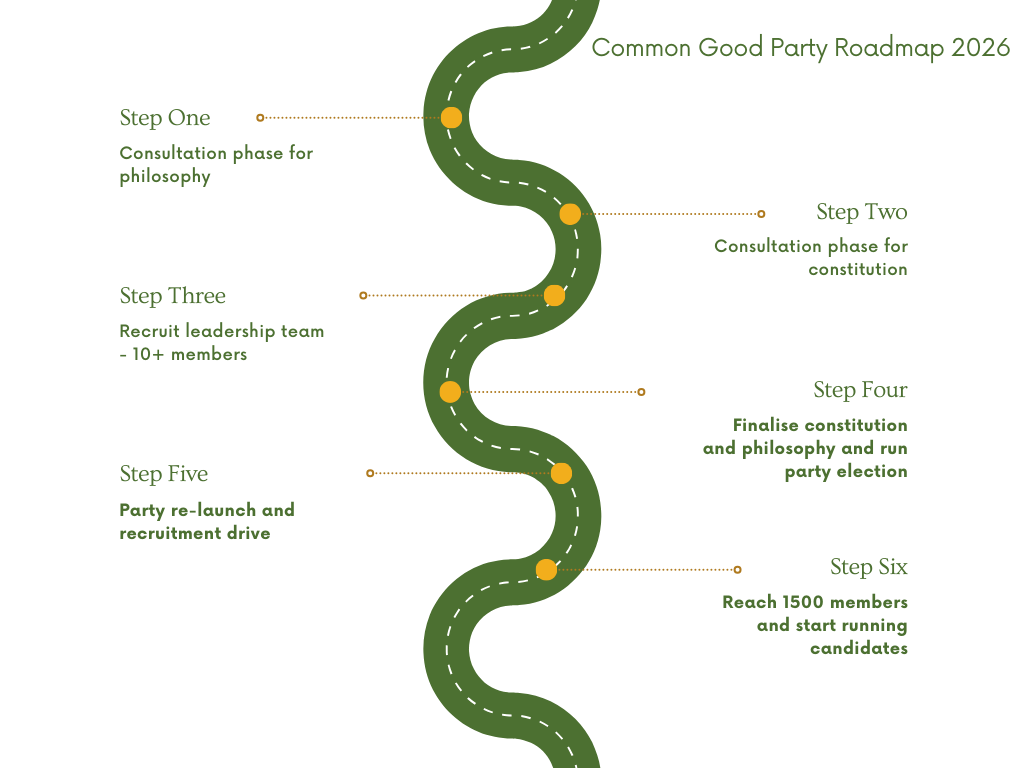
In 2026 our silence ends. Since our foundation we’ve been aiming to create a political movement that lasts generations. For this we need a constitution and philosophy.
Our constitution will provide a robust system of governance. It will work with our current membership and help us run smoothly when we have many members in government.
We need a philosophy because we have members from very different backgrounds. We want everyone to know what we stand for so they can stand with us. We need to make fairly consistent moral judgments. Our formation was driven by compassion for refugees, action on climate change, life and family, and religious freedom. That is a slither of what we care about. Our philosophy will help any party member develop sensible policies on any topic.
Over the next three months we will share sections of the philosophy for discussion by everyone. In early June will release the draft constitution for comment.
From there we will build the next stage of party leadership. Since the start of our party, we have had a small group driving things. We are looking for 10+ capable people committed to driving the party forward for the next year.
Here’s the plan
> Over the next 2-3 months we are going to release the philosophy for consultation.
> In early June we will release the constitution for consultation.
> Throughout this period we will aim to begin identifying 10+ people to help turn us from a moustacheless dictatorship into a fully-fledged political party.
> In the later half of the year, we will enact the new constitution and vote in the new leadership team.
> Our leadership team will then begin party activities in earnest. We will develop policy, make our presence known, run a membership drive to achieve registration, and seek to compete in elections. We may even do some fundraising.
Watching the world burn is fun, but it’s time to speak.
If you want a better world, you need to help.
Tell others about us an talk to us if you can help drive our party forward.

What's behind the political chaos?
Opinion Piece
There’s been some chaos over the last few weeks
- One Nation has seen support of over 20% in several polls, the significance of which has been underreported.
- The ALP has rushed through new hate speech laws, which will potentially impinge upon free speech.
- The Nationals have split from the Coalition over those laws after several of their frontbench members crossed the floor and voted against it and then received disciplinary action from the Liberals.
The immediate catalyst for the jump in support for One Nation (who are mostly against immigration) appears to be the public reaction to the Bondi massacre. This has then put pressure on the National party, which stands to lose several seats, and appears to be driving the split in the Coalition. See here.
Why the political impact now though? We have had resentment against immigration in Australia for some time and events such as the extremist Lindt cafe siege in 2014 have not caused such a political ruckus. What is different now?
There's the impact of social media, the distrust in institutions since covid, but to me one thing stands out above the others: The economy.
Particularly since Covid, things have got worse for poor Australians. We have had:
- Persistent inflation.
- Stagnant wage growth.
- A growing housing crisis that is transferring every dollar it can from the poor to the rich.
The response of the major parties has been woeful. They have pretended to address these problems with nice sounding policies while pandering to rich Australians (in housing and superannuation). They have done absolutely nothing that will fix the major structural problems in the Australian economy and their housing policies have actively made the problem worse. Our politicians are driving Australia off a cliff because it will hurt to slam on the brakes.
Many Australians just don’t buy it any more. More than a third of formal votes last election were for parties other than the ALP and Coalition and it appears that even more are willing to vote for anyone willing to force change now.
What could happen from here?
It’s extremely difficult to predict. I have a few thoughts:
- I think it’s likely Andrew Hastie will take over the Liberal leadership. As he is seen as a conservative with genuine conviction, he will likely be able to win back some One Nation votes. He may be able to temporarily restore confidence in the Coalition.
- The National party may reevaluate and turn more conservative on immigration and social policy.
- One Nation has been divided for years and, even if successful in the next election, I suspect will fall apart again. While earnest, Hanson has not shown herself able to keep the party united.
This is all in the short term though. Long term it depends on what the major parties do.
Will they actually address the structural problems in the Australian economy that have killed the Australian dream and continue to make the rich richer and the poor poorer?
If they do, the major parties may maintain the traditional dominance they have had over our politics.
If they don’t, the alternatives will grow, often from the extremes, and they will be swept away.
What’s needed to fix the problem?
In short, politicians and political parties that are willing to work for the common good of all Australians. We need politicians willing to take on the vested interests in the housing market and Australian economy more broadly to make Australia affordable again. Australia is a rich developed economy and Australians should have no trouble living comfortably.
I hope I’m wrong, but I don’t see either major political party as having the guts to address the real problems right now - the political pain just isn't quite high enough yet - which means we’re in for alternatives.
Most of these are on the fringes and often extreme, but they don’t have to be.
For some time we have been trying to establish a serious party committed to the welfare of Australians. One that is willing to make decisions to make the country better for the long term. Help us do this. Tell your friends about us or get in touch with us to discuss ways you might be able to help.
In a world that appears to be on fire, it can be disheartening to look on feeling powerless to do anything to help. We can make a difference though and there is power in numbers. Join us as we fight for the common good in Australia.
Pro-Life Is Not a Religious Movement

Religious people have been at the forefront of pro-life activism for decades, to their credit. But it has led to a misconception that to be pro-life is to be religious. In reality, the pro-life tent is broad and the reasons for protecting the unborn are varied. It is essential that the pro-life movement (and pro-life parties like the Common Good) make room for people of all backgrounds who want to stand for the dignity and value of every human life. We need every pro-life person working together to best pursue our goals. So here are 3 good reasons why pro-life is not a religious movement.
-
Science backs it
Scientific consensus is clear: in utero humans are alive. From the moment of fertilisation, a new human organism is formed — genetically distinct from the mother and father. This is not a matter of theology, but of biology. The unborn child has a heartbeat by around six weeks, brain activity not long after, and continues to develop with complexity from the earliest stages. Denying this biological reality is not scientific — it’s ideological. -
Ethics backs it
Medical ethics is guided by four key principles: autonomy, beneficence, non-maleficence, and justice. In debates about abortion, autonomy often takes centre stage — a woman’s right to choose. While autonomy is important, it cannot override the other pillars. Non-maleficence (“do no harm”) and beneficence (actively doing good) require us to consider the harm done to the unborn. Justice demands that we protect the most vulnerable — including those who cannot speak for themselves. And this is barely scratching the surface of the ethical argument against abortion. In Australian law unborn life is recognised when wanted — consider Zoe’s Law in NSW, which allows the recognition of a foetus as a victim if harmed in a crime. If the value of unborn life is acknowledged in such cases, why not consistently? -
Secular people back it
Today, more secular voices are emerging and speaking up for the unborn. In the United States, Secular Pro-Life is a growing organisation advocating for the human rights of the unborn without religious argument. Their message? You don’t need faith to believe that every human life deserves protection. The pro-life position is a human rights issue — and that transcends religion.
At the Common Good Party, we believe protecting unborn life is a matter of justice, compassion, and reason. Whether you are religious, spiritual, agnostic or atheist — if you believe in human dignity for all, we invite you to stand with us.
Is Populism dead?
Many commentators have written that this election is a victory for the middle, the death of populism in Australia, and the end of the culture wars.
It’s a nice thought, and while it might be a temporary win for the middle, it’s fundamentally wrong.
The majority of Australians don’t like Trump, his capriciousness to allies, or his instability, but Australia is still fundamentally divided into hostile camps and has generational economic issues inflaming the issue.
The Greens vote remains very strong at around 12% in the Senate and they remain committed to many radical social and economic changes. Other left wing minor parties would add to this figure.
On the opposite side of the political spectrum is a bunch of minor right wing parties, who combined got around 12% this election. Many in this group are committed to fighting the culture wars and promoting some fairly eccentric policies.
Additionally, while the ALP has thankfully appeared to have taken a pause on their social agenda, I am not convinced that they have permanently stopped. I expect them to pick it up again in the future, given the views of many of their MPs.
Meanwhile the Liberal Party continues to offer no economic solutions for the average Australian as their conservative and progressive factions argue over whether their election defeat was due to too much conservatism or a lack of conviction.
Neither the radical progressives or conservatives are going anywhere and many in these groups see the threats to society as grave.
On top of this, we have a major cost of living crisis for the working class and an increasingly hollowed out middle class. Economic hardship is fertile ground for radicalism and with the ALP not properly addressing the cost of living or housing, this situation is likely going to end in a dumpster fire.
Thus with both economic conditions and committed partisans stoking the flames, populism and the culture wars are here to stay.
So, how can Australia fix these issues?
To address the issues culturally, we need leadership that shows real respect and grace. While we saw glimmers of this in Dutton’s and Albanese’s post election speeches, we need more than hints of statesmanlike leadership to encourage meaningful change.
Economically, we need real reform that genuinely improves the living standards of average Australians. We need affordable housing and taxation reform. The massive wealth transfer from wage earners to asset holders over the last 30 years is corroding our society. Our superannuation system was designed to ensure retirement security. The rich now use it to get even further ahead - and who can blame them for using the rules to their advantage!
We need politicians willing to think generationally and do what’s best for the country rather than what’s best for re-election.
How can you fix it? Join us. Our voice is small, but with more members we can speak truth and hope into a disappointing political situation.
Election Analysis
The results are in and the ALP have won the election with a comfortable majority. They have increased their primary vote about 2% to 34.7% since last election and won the two party preferred vote handsomely.
On the surface this looks like a landslide victory for the ALP and anyone in their party will understandably be celebrating.
Yet, when you look at the results closely, the trends should be worrying not just for the Liberals, but for the ALP as well.
The ALP primary vote increased to 34.7%, which is roughly what it was when they lost the 2016 vote to Abbott. The Coalitions vote has dropped by 4%, with further 2% going to other candidates, many of them independents. The combined total of 64.7% for the ALP and Coalition is lower than it has been since 1903.
Independents appear to have picked up a number of seats. The Liberals are facing a crisis as they continue to lose to independents, but the ALP also has the potential to lose Calwell, Franklin, Fremantle, and Bean.
Anecdotally as well, we have not heard many particularly enthusiastic about this election, and when I think about when the campaign seemed to shift, it was when Trump started threatening to annex Canada and wildly brandishing tariffs.
So is Canada a good place to look to explain the election? Several months prior to the election, the conservatives in Canada were winning by 20 percentage points. After Trump's antics, the liberal (progressive) party ended up winning a minority victory. The large swing against Dutton causing him to lose his own seat may also be evidence of this backlash against Trump’s instability.
It’s hard to tell the actual impact of these events and Trump clearly hasn’t influenced our election as much as the Canadian one. There are other factors like interest rates, the cost of living, the Liberals controversial nuclear policy, Peter Dutton himself, and a tidy ALP campaign. But… we’re not convinced that this election is a ringing endorsement of the ALP’s direction.
There are good things about the ALP’s election promises and we hope that they keep many of their commitments. We hope they actually increase housing construction and are glad that super won’t be tampered with. Their improvements to medicare are great and we look forward to their bulk billing and hope they can address the GP shortage.
With this clear victory the ALP now has the political capital to enact their promised changes and real reform.
Will they use it wisely though? Will they properly address the issues that have been continually ignored by our politicians?
Will they actually take the steps needed to properly fix the housing crisis?
Will they actually look at addressing inflation and the cost of living crisis?
Will they actually look at fixing the ongoing crisis our education system is in?
Will they actually make the hard choices that need to be made on defence?
Or… Will they continue to kick the cans down the road as they have been for a decade?
Will we back here in 3 years, with nothing changed, the population even more disillusioned, frustrated, and angry at an Australia that no longer works for all Australians?
We hope for the best, but in the meantime will be busy. We want to compete in the next election and offer a positive choice for Australians.
Sign up to the Common Good party and help us work towards actually solving these long term issues.
Opinion: Why Australia doesn't want affordable housing

At the Common Good we try to be generous in our judgements and optimistic in our outlook.
On housing our hope has turned to cynicism.
Since we published our first article on house prices in 2021, houses have risen a further 26% (this is a total of 43% on pre-pandemic levels).
Why hasn’t this issue been fixed? Why has it been made worse?
Quite simply, Neither the Coalition or the ALP want to fix it. Both parties want high house prices.
With 60% of Australians being home owners, both parties expect that house prices dropping would lose them an election and thus are committed to high house prices.
Both parties theoretically care about affordable housing, but only on the condition that house prices don’t fall.
What is the result of this contradiction?
Lip service to affordable housing, acting like they care, and policy announcements that look like they will address the issue, but won’t.
The result is to make housing “affordable” by adding to demand and giving a few first home buyers more access to debt, grants, super, or shared equity schemes. This increase of demand then pours fuel on the dumpster fire that is Australian house prices and policy.
Both the ALP and coalitions are giving us more of this garbage this election.
Our politicians aren’t stupid. They know what the impact of their policies will be. They lack the moral fortitude to attempt to fix this generational crisis.
The solution to affordable housing is simple economics:
Increase supply, decrease demand.
International Students Aren’t the Cause of the Housing Crisis

In recent weeks international students have been thrown as a political football into the discussion on housing. Labor has already made it harder to get student visas, and now the Coalition has announced even tighter caps, along with significantly higher visa fees.
Housing should be the major focus this election, but blaming international students won’t fix the issue.
The reality is that Australia’s housing crisis has been years in the making. For too long we haven’t built enough homes to keep up demand, which combined with favourable tax treatment for housing investments and a lowering of interest rates has resulted in eye watering prices. International students are not to blame for these issues.
But… Do international students contribute to demand? Yes, but oversimplified and ham-fisted policies will be more harmful than helpful.
First off, we need to distinguish between short term international students and permanent migrants. Temporary students who are here only for a few years have some impact in the short term, but it’s pretty limited. On top of being temporary, many students live in university provided or specialised accommodation, or stay with family or in shared housing.
They also have a very positive impact on our economy. They pay us a lot of money through fees, accommodations, and general living expenses that add jobs and contribute to our economy. They also take a lot of jobs that many Australians would not want to, such as working in the gig economy.
Those who go on to acquire permanent residency, which we have encouraged for many years are a different calculation. On one hand, these migrants are very positive for Australia. We gain young and skilled people in key industries at a very cheap price. This is undeniably beneficial. On the other hand, it is undeniable that these migrants contribute to housing demand.
Given the severity of the housing shortage, we think it’s reasonable to look at migration settings in the short term. We support a strong migration program in the long term, but we think there may need to temporarily reduce permanent migration until housing supply catches up.
It’s important that any changes in this area are thoughtful and it’s important that international students keep coming to Australia. Our universities are a valuable industry and blanket caps and steep fees risk undermining this industry. It would hurt universities, local businesses, and the towns these are in.
So let’s not scapegoat international students. Tinkering with migration may be necessary in the short term, but ultimately we need to start fixing the real problem by building more houses.
Voting with the Vulnerable: Homelessness

Every year, thousands of people across Australia seek help from homelessness services—only to be turned away. Thousands more will call homelessness helplines but their calls won’t even get through to an operator. Not because their needs aren't real, but because the services they turn to are underfunded and overwhelmed.
At the Common Good Party, we believe this is a national crisis that demands urgent, coordinated, and compassionate action delivered in a fiscally responsible way. This article will highlight what homelessness groups are calling for, what the major parties are offering and what the Common Good Party would put forward to address this issue.
Public Support, But Not Yet Public Policy
Polling shows most Australians support increased investment in homelessness services. The public understands what the data confirms: this issue isn't going away on its own. Rates of homelessness have now outstripped pre-pandemic levels. Despite widespread support for action, homelessness services remain stretched thin. To turn the tide, Homelessness Australia—the country’s peak body for homelessness advocacy—has outlined clear priorities: prevention, early intervention, rapid rehousing, and upscaling successful models for groups with complex needs.
Prevention and Early Intervention
Homelessness is preventable in up to 80% of at-risk cases that could be stopped before they become crises—with the right support at the right time. That includes financial assistance, mental health support, domestic violence responses, and secure tenancies.
Rapid Rehousing
For people already experiencing homelessness, rapid rehousing is critical. Proposed solutions by homelessness groups include an “escaping homelessness” welfare payment to help people transition quickly into secure housing. They also advocate for an expansion of models like Housing First, which provides permanent housing for those with complex issues who may otherwise face chronic homelessness.
Affordable Housing
The housing market is a key driver of homelessness. With skyrocketing rents and a lack of low-cost options, too many Australians are just one crisis away from losing their home. Homelessness advocates are calling for 10% of all housing stock to be low-cost or social housing (currently 4.6% of housing is social housing), alongside an increase in rent assistance to reduce pressure on the most vulnerable households.
What Are the Parties Offering?
Liberal Party
-
Expanding youth mental health services
-
Grants for emergency accommodation refurbishments
-
Emergency housing for women and children escaping domestic violence
-
Increase housing construction, although there is no specific target for increasing social housing
These are welcome but modest commitments, focused mostly on emergency responses, with limited vision for prevention or long-term housing.
Labor Party
-
$1 billion for transitional and crisis housing
-
$6 billion for social housing
-
$500 million for homelessness services
-
$100 million Homelessness Innovation Fund
-
$120 million for localised responses
-
Funding for mental health and youth care centres
-
$6.2 million for advocacy groups
While Labor’s commitments are significantly larger and more comprehensive than the Coalition’s, homelessness organisations say prevention has not been prioritised, and more could be done for priority groups such as youth and First Nations people.
Greens
-
Mandate 30% public housing in all new developments
-
Fully funded wraparound support services
-
$5.2 billion commitment including:
-
50,000 supported tenancies
-
40 supportive accommodation centres
-
Doubled funding for homelessness services and public housing
-
50,000 supported tenancies
The Greens’ platform represents a highly ambitious investment in public and supported housing.
Family First
-
No detailed policy commitments
-
Support in principle for strong welfare safety nets
-
Proposed communal shelters for rough sleepers
While showing moral support, the party lacks actionable plans to address homelessness in a systematic way.
Our Position: Common Sense for the Common Good
At the Common Good Party, we believe addressing homelessness is a moral imperative and a policy priority. The cost of homelessness is huge: in terms of human dignity, social stigma and adverse health outcomes.
From the start the Common Good has had a strong commitment to liveable incomes, effective welfare systems, affordable housing and evidence-based approaches to domestic violence and poverty. Our current crisis needs a long-term and substantial financial commitment to those in our community doing it the toughest, that encompasses prevention and intervention.
What could this policy look like in practical measures? Here is a breakdown of potential actions.
Housing focused
- Increase public housing levels and adequately maintain current public housing stock
- Firstly, increase housing supply to help stem exorbitant rent rises
- Emergency housing available for all victims of domestic violence. Are there other demographics who might need emergency housing too? Perhaps relational breakdown that doesn’t involve violence?
Income based
- Liveable incomes. Someone on a full-time income should be able to rent a reasonable distance from their work, even if in a sharehouse.
- Reform Jobseeker: rates need to realistically help people day to day and pathways to employment can be improved
Health based
- Improve access to mental health and drug and alcohol services
- Promote healthy relationships in all policies to address relationship breakdown as a cause of homelessness
Specific Groups
- Holistic and evidence-based services to help those sleeping rough
- Particular funding for groups more at risk of homelessness including Aboriginal and Torres Strait Islander people, youth and older people
What do you think are the priority actions to address homelessness?
Join today and help seek the common good for all, including our most vulnerable
Opinion: Democracy isn’t solving our problems and needs to
Worldwide there has been a fearful shift away from democracy and a shift to (mostly) right wing extremism.
While Trump flirts with authoritarianism, the USA has become more tribal and struggles to even communicate with an agreed upon language or set of facts.
In Europe the situation isn’t good either. In most countries the extreme left and right are growing, with the middle shrinking to levels where they risk losing power.
What on earth is going on?
Economically, many years of globalism and catering to vested interests has resulted in a massive accumulation of wealth by the richest few in society.
Socially, the left wing of politics has pushed its social agenda through the law and institutions such that people with conservative social views have felt increasingly excluded from society.
Economically, people have seen that the mainstream political parties have failed to ensure that a working class job provides a reasonable standard of living and people.
Socially, society has also split in two as those with conservative social views have turned against the institutions that have been weaponised against them. Language has changed, become hostile, and the left and right struggle to communicate with each other.
Democracy has not addressed the concerns of voters and voters are beginning to turn against democracy.
Democracy is not solving Australia’s problems either
Australia faces a cost of living crisis, a housing crisis that will cause a baby bust for a generation, and an increasing tribalism and winner-take-all approach from our far left and right.
These issues have existed for years and yet our democracy has not even started to substantially address them.
Why not?
Vested interest, short sightedness, and politicians focussing on reelection rather than the good of the nation. It’s not because the solutions take years to impact, it’s because they haven’t been implemented and the Government does not want to implement them, though they pretend.
On housing, both parties want high house prices because 65% of voters own a home and they don’t want to be kicked out if they drop.
On the cost of living, the government won’t act to reduce inflation because it would involve painful vote-losing cuts, stopping free money handouts, and reducing the ludicrous size of our mortgage debt to allow interest rates to be raised.
On tribalism, our politicians are too interested in short term political gain and too afraid of those with dogmatic ideological commitments. We need politicians promoting a vision where our tribes seek to coexist in society rather than seeking to dominate it.
Vested interests, short-sightedness, and a focus on reelection are sabotaging the long-term good of the nation.
Democracy needs to solve our problems and it isn’t.
We demand better.
The only way for this to change is for YOU to demand better.
You can do this in any political party, but we invite you to do it through our party.
Join us in our fight for the Common Good and a better world.
Unreliable - Trump and Australian Foreign Policy

This looks far too much like a horror film to those who understand modern history. By threatening to abandon Ukraine and his European allies and instead work with Russia, Trump has upended 80 years of American Foreign Policy and is reshaping the world in a terrible and brutal way. Without America supporting the rules based order, we are in a world where the strong do what they can and the weak suffer what they must.1
What does this mean for Europe?
As it stands, America is no longer a reliable ally for Europe.
This is a disaster. European underinvestment and freeloading in defence has been starkly revealed as they now face confronting Russian aggression with the prospect of no American support.
Europe now has a choice. They can make the difficult decisions to invest substantially in Ukraine’s and their defence, or they can accept a large amount of risk as to Russia’s future actions.
The question is not one of capability, but one of European political will. Russia’s economy is not much larger than Australia’s, Europe has just, so far, been unwilling to pay up.
If they make the hard choice as some like Poland and the Baltic states have, it will likely be sufficient, but given European disunity, naivety, and the temptation to freeload within Europe, there is no guarantee of that.
What does this mean for Asia?
It’s very bad. While the USA is ostensibly prioritising Asia, the very same arguments used to justify a withdrawal from Europe justify a withdrawal from Asia. America’s involvement in Asia is no longer entirely reliable.
Were America to withdraw from the region, every country in Asia would have to adjust to the new reality of Chinese dominance in the region.
It is probable that we would also see Japan and/or South Korea developing nuclear weapons to protect themselves from Chinese coercion. Given Ukraine’s experience in giving up nuclear weapons and that of actors like North Korea, it appears that a Nuclear deterrent may be the only foolproof protection a country can have.
What does this mean for Australia?
It’s bad. While the outlook may change quickly, it appears that America is no longer a reliable long term ally.
In the short term, we still have to rely on America. We don’t have a choice as we haven’t made the investments required for a more independent foreign policy.
The choices we make today, however, will decide what options we have in the future.
The main threat we face is that of Chinese Communist Party (CCP) coercion. The CCP is active in influencing Australian politics internally and we have seen their coercion in hostile trade actions aimed to change our political decision making process.
Spending more on defence will cost substantially but, depending how we spend it, will give us more options and a better potential to resist coercion in the future.
We still hope that the USA will prove reliable in Asia and are not advocating withdrawing from the alliance, but the time to prepare for contingencies is now.
Postscript
We all wish that we didn’t have to invest money in defence and we hope those weapons aren’t used. Money spent in defence inevitably means money not spent on schools, hospitals, social welfare, and consumption. In a world with bad actors, however, you either spend money on defence, or you place yourself at the mercy of those bad actors.
With the election coming up, we hope to see seriousness and long-term thinking that been lacking in discussions on defence up till now.
Read moreWhere's the Common Good in the US Election?

Who would we vote for in the American election?
What do we think of the American election?
Why is the Common Good needed?
YUK! What an awful choice. To vote for a person with a flawed character who is a threat to democracy, or to vote for a person determined to undo recent progress in protecting the unborn and limiting abortions. Luckily, we have a solution. Vote for a third party candidate!
Our pick of the alternatives is the American Solidarity Party, who are promoting values that resonate with ours such as communal welfare, social justice, and moral responsibility. Their vision offers lessons for us and everyone who is seeking to prioritise collective well-being over divisive partisanship.
Core Values of the American Solidarity Party
Like the Common Good Party the American Solidarity Party is relatively new, formed in 2011. The American Solidarity Party’s foundation is in Roman Catholic social justice teaching, which emphasizes human dignity, the sanctity of life, and the importance of community. While we do not have this sort of explicit Christian foundation at the Common Good, their values and political aims overlap with ours: advocating for policies that promote social justice, environmental stewardship, and economic equity. Their platform focuses on the common good, seeking to reconcile individual rights with the needs of the community.
Key issues for the ASP include protecting vulnerable populations including the unborn, advocating for humane immigration policies, and promoting a living wage. Their stance on healthcare reflects a commitment to universal access, viewing it not merely as a commodity but as a fundamental human right. This principled approach underscores a belief that the well-being of individuals is intertwined with the health of the community at large.
Achievements and Successes
While the American Solidarity Party operates in a political environment dominated by two major parties, it has made notable progress since its formation in 2011. In that time the party has put forward candidates on a national, state and federal level, with several ASP members now serving on local councils. The ASP also claims to be the fastest growing political party in America, and saw a significant increase in votes between the 2016 and 2020 presidential election, from 6000 votes for their candidate in 2016 to 40 000 in 2020. In 2024 presidential candidate Peter Sonski is looking to increase vote numbers once more with the platform of “Pro-Life. Pro-Family. Pro-Worker.”. When asked recently in an interview why campaign for an election he won’t win, Sonski reflected on the incredible opportunities the presidential election brings for visibility and new membership. Their grassroots campaigns have attracted a dedicated base from both the left and right, particularly among voters seeking an alternative to the prevailing political dichotomy.
Lessons for the Common Good Party
For the Common Good Party in Australia, there are several key lessons to draw from the American Solidarity Party's journey.
- There is a need for the Common Good and messages similar to ours have resonated in other countries. We are needed to be the voice of Common Good in Australia and we certainly can have success in growing our party and making an impact.
- Think big, act local: The ASP has demonstrated a commitment to advocate for the common good at every level of government. They take on presidential elections whilst encouraging active participation in local decision making. This has allowed the movement to grow nationally, but is driven by vibrant local chapters that can cultivate a sense of ownership and empowerment among constituents. Their relative success at a municipal level highlights the importance of addressing immediate community concerns.
- Know your audience: The ASP has found much of its support in Catholic media and community organisations that align with their values. The Common Good Party could benefit from seeking partnerships with environmental groups, social justice organisations, and faith-based communities to amplify their message and reach a wider audience.
- Clear, Compassionate Messaging: The ASP has effectively communicated its values in a way that resonates with diverse audiences. A clear, compassionate narrative around the importance of the common good can attract support from those who may feel disillusioned by traditional politics.
- Play the Long Game: Like the Common Good Party, the ASP still has a long way to go to make the impact they desire. But what they do have is a clear vision and values, and relentless optimism that they can create the positive change they long for in the US political landscape. We also need to keep our eyes on the prize, and not be discouraged by the long road ahead. Who knows where we might be in another 5 or 10 years?
In conclusion, the American Solidarity Party serves as a compelling example of how a political movement can prioritise the common good. By reflecting on their values, successes, and strategies, the Common Good Party in Australia can strengthen its own mission, and become a beacon of hope and a champion for collective welfare in the political arena.
Common Good Discussions: Turning Back the Boats

Our society has forgotten how to disagree with each other.
We’re bringing it back.
Welcome to our new section for the airing of opinions that don’t always fit the party line, but are worthy of discussion and thought. This section will aim to present two sides of an argument.
We thought we’d start off with a controversial one.
Turning Back the Boats - Stuart Southwell
I think we should have turned back the boats.
Consequences are important in ethics.
The ends don’t always justify the means, but the consequences cannot be excluded from ethical decision making.
Welcoming the boats feels like the right thing to do. It feels warm and fuzzy. We see the stories of the refugees who are welcomed this way. This open embrace, however, has a dark undercurrent.
Approximately 1000 refugees drowned trying to get to Australia on unsuitable boats and we don’t hear those stories.
The story of the lone child sent to safety by their parents who never made it.
The story of the mother holding her baby above the water as they both drown. Those stories are all at the bottom of the ocean.
Stopping the boats feels wrong, but letting them come cost lives.
Allowing boats feels warm and fuzzy, but if our choices continue to allow people to die risking their travel, that is an unethical choice.
The consequences cannot be ignored.
The ethical path is to swallow our moral “purity” so that others don’t swallow water.
There are of course many caveats to this, particularly if the issue is not a binary choice. We should also of course do other things to take care of and support refugees in safe ways.
I’d rather have a policy that is good rather than feels good.
But is there a better way? - Bridget Allen
It is a heartbreaking thought to think of those who have died trying to make it to our shores.
It also chills me to think of those who in practice were locked up and the key thrown away. Those who were stripped of hope and humanity. Men, women and children who were so traumatised by their treatment by our country that death seemed like an escape.
So was it really a case of one or the other? A choice between deaths at sea or human rights abuses on our shores?
I contend that other alternatives existed. Perhaps I am an optimist but I think moral conviction and imagination can take us a long way.
One such alternative I recently heard of was an NGO group in Europe using rescue boats to save those attempting dangerous passages to safer shores. And they delivered refugees to countries that for the most part dealt with them more humanely than we did.
I do not think we properly examined more humane options before we "stopped the boats". There must be a better way than turning our backs to the immense suffering of those who have fled their homes.
But what do you think?
The Voice and The Common Good

What is the Voice referendum?
On October 14 Australia will be asked to vote yes or no to the referendum question regarding the Indigenous Voice to Parliament. As a party we have found this issue difficult to engage with. On one hand, we love the idea of the voice as it will allow Aboriginal and Torres Strait Islander perspectives to be heard by those in power, hopefully leading to better policies and better outcomes, which are desperately needed. On the other hand, placing a race requirement for a body into our constitution cuts against some of our egalitarian values. Alongside this, while we would prefer that ideas are judged on whether they are correct rather than who is saying them, we are also aware that our party is predominantly white and are mindful of the negative impacts a no vote may have on indigenous people and reconciliation.
The question we will be asked to vote on is as follows:
“A Proposed Law: to alter the Constitution to recognise the First Peoples of Australia by establishing an Aboriginal and Torres Strait Islander Voice.
Do you approve this proposed alteration?”
If the yes vote wins the following will be added to the constitution:
In recognition of Aboriginal and Torres Strait Islander peoples as the First Peoples of Australia:
- there shall be a body, to be called the Aboriginal and Torres Strait Islander Voice;
- the Aboriginal and Torres Strait Islander Voice may make representations to the Parliament and the Executive Government of the Commonwealth on matters relating to Aboriginal and Torres Strait Islander peoples;
- the Parliament shall, subject to this Constitution, have power to make laws with respect to matters relating to the Aboriginal and Torres Strait Islander Voice, including its composition, functions, powers and procedures.”
Essentially, this means that an advisory body would be created that the parliament has the power to shape and change, but would need a referendum to abolish. Constitutional recognition of Indigenous peoples is therefore given through this Voice to Parliament being established in our constitution.
There are a lot of misconceptions out there and we thought an FAQ may be a helpful way to address the issue.
FAQ
Where did the idea for the referendum come from?
The question of constitutional recognition for Aboriginal and Torres Strait Islander people has been around for decades, including during the 1999 republic referendum. The idea for a constitutionally enshrined Indigenous advisory body was first proposed by Aboriginal lawyer Noel Pearson in 2014. In 2016 a Liberal government appointed Referendum Council delivered a discussion paper on constitutional recognition and the voice and this was endorsed by First Nations leaders in 2017 in the Uluru Statement of the Heart. A Voice co-design process culminated in the 2021 report Indigenous Voice Co-design Process panel final report, also referred to as the Calma-Langton co-design report. This process has led to the current referendum.
Why haven’t we been given more information about the laws and why aren’t we voting on them? What would the Voice actually look like?
Parliament has made the decision that the referendum will only be about whether the Voice will be put in our constitution and not the specific legislation. If approved, it will then be the job of the parliament to decide how the Voice is composed and the parliament will also be able to change the structure of the Voice in the future. The suggested model described in the Calma-Langton co-design report, which describes a 24 person National Voice, with 2 representatives from each state or territory, an additional 5 members for identified remote areas in the NT, WA, QLD, SA and NSW, and a representative for Torres Strait Islanders living on the mainland. This document also proposes that members of the National Voice being determined by smaller local and regional Voice bodies. While the government has not formally committed to any model at this point, we think it extremely likely that this proposed model would be adopted.
What does the Voice do? What power will it have?
The Voice will be able to make representations to the parliament and executive about laws and policies that relate to Aboriginal and Torres Strait Islander people. It has no power to compel the government into any action, introduce bills, vote, delay voting, or veto any legislation.
How would the Voice referendum pass?
The referendum will pass if there is a double majority - a majority of voters who support the referendum nationally, and a majority (at least 4) of states in favour of the referendum.
Do Aboriginal and Torres Strait Islander people support the voice?
While it’s challenging to get a representative sample of Indigenous people and it is possible opinions have changed since, two polls of 300 and 738 indigenous people conducted in January and March showed that 80% and 83% were in favour. Despite the limitations of the data, this is a strong result and we would expect that there would currently be a strong majority in favour amongst the Indigenous population.
How does the Voice relate to Treaty?
The Voice referendum is not considering the idea of treaty - a binding agreement between the government and First Nations peoples that sets out the terms of engagement and obligations of all sides. Consequently the treaty is not relevant to the current debate.
What is great about the Voice and constitutional recognition?
Aboriginal and Torres Strait Islander people have a unique place in our country as our First peoples and it is right that we recognise this. Our First nations people have a rich heritage and so much to offer, but they also have the unique position of having experienced significant violence, oppression and human rights atrocities such as genocides and the Stolen Generations. It is right then that we have systems in place to ensure the evils of the past are not repeated and current inequalities in areas such as health, life expectancy, income and employment are addressed.
The Voice has a potential role to help do this. Firstly, by ensuring governments always consider the perspectives of Aboriginal and Torres Strait Islander peoples in laws that affect them, it helps shift the dial further from paternalism and towards self-determination and reconciliation. It is clear from current evidence that collaborative action with Aboriginal and Torres Strait Islander people on the issues that affect them is more effective than any imposed solutions. (1)
Secondly, a constitutionally enshrined Voice means that governments will always be compelled to consult Aboriginal and Torres Strait Islander people on important issues. This is significant given five Aboriginal advisory groups have come and gone at the will of different governments over the past five decades. The Voice will mean an instrument for consultation will outlast any particular sitting government, giving stability and certainty to First Nations people that their perspectives will be heard.
Lastly, it is not insignificant that the majority of Aboriginal and Torres Strait Islander people are in favour of the Voice - approximately 80% in the polls mentioned above. As we seek reconciliation, self-determination and a more compassionate approach to our First Nations people, a yes vote would demonstrate we are listening carefully to what Aboriginal and Torres Strait Islander people say will help them to have the same opportunities and experiences as every other Australian.
What are our reservations?
Despite the potential positives, there are significant concerns held by some of our members.
Primarily, while the Voice will not have any decision making power itself, it will be a form of political influence and power that is constitutionally given to one group of racially defined people, which cuts against our desire for equality. Governments, according to this view, should not legislate on the basis of race even if the goal of race based legislation is to put everyone on equal footing. This is because in some sense, this kind of legislation elevates the inherited (and not chosen) characteristic of race so that it determines a person's eligibility for participation in some societal programs. This may then actually have a counterproductive effect of contributing to the concept of racial distinction as being relevant to a person's societal worth or role and many jurisdictions such as France and Germany do not practise affirmative action for this reason among others.
While the power to legislate based on race has always been in our constitution, the solution to this should not be seen as adding more race-based content, but rather by amending the previous content.
In addition to these philosophical objections, while we hope that any Voice created will be a force for good, there are no guarantees about what the Voice might become in practice. It is possible that it could become politicised, not represent indigenous people fairly, or even result in parties and factions lobbying for positions in the voice to push particular political agendas.
The Voice will create bureaucracy and also cost some money and there are questions over whether the Voice will always remain relevant. Might it be possible that over the course of a century or two we actually move past race as a division in our society and we are left with a constitutionally enshrined body unsuitable to the context that we are unable to remove? As can be seen it is hard to change the constitution, but especially to take something away.
So where does the Common Good Party stand?
The majority of Common Good Party members are likely to vote Yes in the referendum. 65% of those participating in our recent poll indicated they were in favour or leaning towards the voice. In that sense our party is in favour of the Voice. A further 16% were unsure and 23% were against or leaning against. While those voting No constitute a smaller proportion of our party, we want to acknowledge the concerns of those voting No and don’t believe that this issue becoming divisive is likely to be beneficial for our nation. Ultimately we would like to encourage everyone to vote with their consciences for what they think will be best for Australians. We would urge everyone to consider deeply and compassionately the impact on Aboriginal and Torres Strait Islander people as they do this.
1. Overcoming Indigenous Disadvantage: Key Indicators 2020. Productivity Commission. Chapter 3. https://www.pc.gov.au/ongoing/overcoming-indigenous-disadvantage/2020
What kind of society do we want to live in?

About a week ago Andrew Thorburn was appointed as CEO of Essendon Football Club. Soon after, however, he came under public criticism for his association with a church named City on a Hill, which holds a traditional Christian perspective on sexuality. The Essendon board gave Andrew a choice between resigning his position on the board of his church or resigning his position as CEO of Essendon. Asked to publicly choose between his faith and football club, he did as many people of faith would do and chose his faith.
In Andrew’s words, the Essendon Football Club board "made it clear that my Christian faith and my association with a Church are unacceptable in our culture if you wish to hold a leadership position in society." (source)
It didn’t matter that Andrew wasn’t publicly promoting his views on sexuality, the association with a conservative church was enough.
This may be a disturbing watershed moment in Australian history. It will have a chilling effect upon Australian society as organisations with social influence will now consider carefully before appointing Christians to important roles. It seems likely that people of faith with orthodox views on sexuality (those in line with historical religious teaching) may now find themselves with a glass ceiling above their heads for certain roles.
Are we really now in a place where a quasi religious test of sexual orthodoxy is being placed upon secular positions like this?
Is the kind of society we want to live in? How are we all going to live together for the next 100 years?
The reality is that many people living in Australia have deeply incompatible views on many issues. The LGBTI+ movement has deeply held views about human sexuality. Many other Australians have views in deep opposition to this. For many, this is a religious issue.*
Neither side is going to compromise their beliefs and we shouldn’t ask them to.
Neither side is disappearing either. LGBTI+ people are part of the fabric of Australia, but so are people with conservative views on sexuality.
Given this seemingly intractable situation, how are we going to live peacefully together?
It isn’t through hating each other when we disagree. It isn’t through attacking each other’s livelihood. It also isn’t through trying to coerce others to believe the same as us. It isn’t through zero sum games, it isn’t through excluding people from polite society, and it also isn’t through pretending that these issues don’t exist.
We need a better way forward and we at the Common Good Party see a better path.
We need a true tolerance that extends beyond those who think and behave the same as us.
We need a deep tolerance for those who look differently, think differently, believe differently, and behave differently.
We need a real tolerance that accepts and affirms real diversity, where people of different convictions, worldviews, religion, sexuality, and whatever else can feel welcome and peacefully coexist.
We also need our politicians and political participants to validate the importance of all individuals and groups in our society, rather than stoking outrage and fanning the flames of hatred. People of different religions and sexual orientations should feel welcome in sport and society.
We understand that this issue is complicated. Institutions often exist with ideological purposes and it is essential that these institutions be able to maintain their character. Freedom of association is one of the bedrocks of a free society.
We do, however, wonder whether promoting sexual conformity is really a part of Essendon Football Club’s inherent ideological purposes, or whether it is something being pressed upon them.
We'll leave the final words to those in Victoria. There are two very different versions of tolerance being argued.
“Those views are absolutely appalling, I don’t support those views, that kind of intolerance, that kind of hatred, bigotry. It is just wrong… To dress that up as anything other than bigotry is just obviously false.” - Daniel Andrews, Premier of Victoria.
“If you want a diverse society it also means there are going to be people with different views. The question for harmony is whether we can coexist and hear each other and respect each other’s views. It’s that point around I disagree with what you say, but I defend your right to say it.” - Andrew Thorburn.
(source)
*Several commentators insist that views on sexuality aren’t a religious issue because not all religious people have a conservative view on sexuality. This is like saying that infant baptism isn’t a religious issue for Baptist Christians because Anglican Christians are okay with baptising infants. While some religious people do hold modern views of sexuality, many conservative religious people would view this as a significant betrayal of their religion and God. These belief systems may share a name, they are very different in their worldview and are in some ways different religions.
As the Dust Settles from the Election
Just over two weeks on from the election and the dust has mostly settled.
In the House of Representatives, the ALP had a 3.2% swing for them on a two-party preferred basis and has gained eight seats, but has actually had a 0.8% swing against them on a primary vote basis. The Liberal Party on the other hand were soundly defeated, losing 18 seats, with four of these notably to climate focussed independents in their heartland.

(source ABC)
In the Senate, provided ABC estimates are correct, the Coalition will have 31 seats, the ALP 26, the Greens 12, One Nation two, the Jacqui Lambie Network two, and an independent from Canberra one. There are two seats with a very unclear result, which will only be decided after a long distribution of preferences. My guess is these will go to One Nation in SA and the UAP in Vic (The ABC thinks the Liberals might get both). Barring an upset in Canberra or elsewhere, the ALP and Greens will have a total of 38 votes, needing just 39 to pass legislation.

(source ABC)
The end result of this is that the ALP will form a majority Government with firm control over the House of Representatives. In the Senate the ALP, if they have the support of the Greens, will be one short of a majority in a diverse chamber. This will mean that on issues on which the ALP and Greens are agreed, the ALP will also have close to effective control in the Senate. Barring an upset in preferences, the ALP will thus be in a strong position to pass whatever legislation they choose through both houses.
But what are the implications of this election looking forward?
The Liberal party was crushed on climate change. The liberals lost four safe seats to climate focused independents. Worse for the Liberals is that they may face similar challenges in other seats in the future. The Liberal party now faces a choice. Will they adopt a genuinely conservative policy that conserves our planet for future generations, or will they continue with their destructive corruption of conservatism that destroys our future planet for profit? This is a choice the Liberal Party must make, but until they take the obvious lesson on climate change, we doubt they can win another election.
Looking forward, one of the other main points of contention we see is on religious freedom. Since the previous election (2019) the ALP has been making positive noises towards religious voters. Despite this, it appears clear that the vast majority of ALP MPs do not personally support religious freedom and freedom of conscience that cuts against their social values. With the ALP now firmly in control of parliament and no longer needing religious votes to get elected (this time), we will see whether they have a genuine commitment to tolerating social conservative views, or whether their words have simply been a cynical vote winning exercise.
Another takeaway is the collapse in the major party vote. With 31.1% of the vote going to other parties, there is a potentially existential crisis brewing for both the Liberal Party and the ALP. After reforming its views on climate, will the LNP be able to hold onto its city heartland? Is the ALP able to maintain support from diverse groups such as those in the cities, religious voters in places like Western Sydney, and the working class? For these parties to maintain their dominance, they must find an inclusive vision that can appeal to all Australians.
In a great step forward, the Australian parliament now has a record 10 Indigenous members. We look forward to these perspectives being better considered in policy making and the impact this might have on the self-determination of Aboriginal and Torres Strait Islander people. The 47th parliament of Australia also boasts record numbers of women and the first Muslim federal ministers. As our political landscape shifts to better reflect Australia's demographic make-up, we hope for a forward looking and genuinely inclusive society.
We hope for the best. We hope that the ALP is able to run an effective government where people of all social views are welcome. We also hope that the Coalition reforms itself into an effective opposition under Peter Dutton, purges the corruption within it, and takes a position on climate change that conservatives who care about the future can be proud of.
As we in the Common Good Party look to the future, we see that our voice is so clearly needed. While we hope that the climate debate in Australia will now be settled, there are many other unresolved issues. Housing is still unaffordable, refugees are still not treated properly, religious freedom needs protecting, and, tragically, we still lose at least 65 000 Australian lives to abortion each year. The Common Good Party needs a strong voice and as we look forward, we hope that you will join our party and help us advocate for a better future.
Foreign Policy for the Future

As we look to the future in our election series, 2022 has been another year of shattered expectations. Russia’s invasion of Ukraine has been a sharp wake up call to the continued relevance of military power in today’s world. Ukraine is far away, but how should we be thinking about all of this? How can we understand our world and Australia’s place in it? What does a Foreign Policy that looks to the future in 1, 10, and 100 years look like?
Australia is extremely unlikely to be directly invaded, but our region has become significantly less stable in the last few years. In just a few years, an increasingly assertive Chinese Communist Party (CCP) has crushed democracy in Hong Kong, forged a pact with the Solomon Islands with the potential for military power projection, and has attempted to economically coerce Australia into accepting the CCP’s view of strategic matters. Even more concerning is the very real and substantial threat of a CCP invasion of Taiwan. If the CCP could take the democratic island of 20 million people without unacceptable costs, it very likely would. With such dangerous threats to worldwide security, there are some lessons we should take when considering a future focussed foreign policy.
We must have our eyes wide open to the very real threats in the world. Authoritarian regimes have no problems bending the world to their will through economic coercion, propaganda, and military power. We have seen this in the CCP’s brutal suppression of Hong Kong and its military expansion into the South China Sea. Most starkly we have seen it in Putin’s invasion of Ukraine. We may wish we lived in an idealised world where military power does not matter, but as Ukraine is painfully aware, you cannot negotiate with a regime that has made up its mind to enforce its unacceptable will through violence.
We must guard our independence carefully. Those watching the Russian-Ukraine conflict would have noticed Germany’s reticence in placing sanctions on Russia and on sending Ukraine military aid. The reason for this is their dependence on Russian energy. Over the last few years, Germany has traded a part of its political independence for economic benefits, with the cost of regaining that independence being significant economic pain. We have been exposed to similar coercion by China, but successfully resisted this due to our anti-authoritarian mentality, some well-timed effective political leadership, and, ironically (pun intended), China’s reliance on Australia for critical resources (see here for further reading). We should choose the partners with whom we trust our strategic dependencies carefully.
Soft power, espionage, and propaganda are real and effective tools of foreign policy. Russia’s propaganda has been terribly effective in spreading lies and confusion both inside and outside of Russia. Russian propaganda (and repression) has so far kept its populace quiet with a false and frankly ridiculous tale of Russia invading Ukraine to liberate it from its (Jewish) Nazi leadership and destroy bioweapons that Ukraine is supposedly developing. While not directly applicable to us, many of the cities and regions Russia has managed to capture from Ukraine in the last 8 years has been with the aid of locals recruited by Russian espionage. In our own backyard we have suffered (for now) a diplomatic failure in preventing a pact between the Solomon Islands and the CCP, which would allow the CCP to project military power further into our region. While the link between our soft power (influence wielded through non-military means) efforts in the region and this development is unclear, our lack of concern for sea level rise and reduced foreign aid budget have clearly not helped. Power is wielded deliberately and effectively in our world in many ways short of war. For us to prepare for the future, we must be aware of these methods and put the necessary resources towards countering them.
We must avoid careless foreign military intervention. While not the obvious takeaway for us in the West, it is worth noting that for Russia this invasion has been a disaster. Thousands have died, their economy is in tatters, and Putin has put himself in a precarious and dangerous position. While Australia has used military force well in the past (for example, East Timor), we need to be wary of careless military intervention. There is a time to use military force, but it must be used carefully, with good cause, and with specific aims and objectives.
Given all this, what does an Australian foreign policy for the future look like? Our foreign policy goals must be directed towards creating long term peace and freedom in our region. As the Roman general Vegetius said however, “If you want peace, prepare for war.” We must be peace loving, but have our eyes wide open. Until all powers in our region are committed to resolving conflict peacefully, we must develop our neglected defensive capabilities. We must be careful of our strategic dependencies, and we must develop both the hard and soft tools required to counter our competitors. Peace is not free. Freedom is not free. The price of liberty is eternal vigilance.
Kicking the Can Down the Road on Housing
Everyone who isn’t filthy rich knows we have a housing problem. Over the last decades housing has become increasingly unaffordable and excluded many in our society from home ownership. Instead of looking forward and addressing the root cause of high housing prices, however, the solution of the major parties has been to provide some pain relief to first home buyers and kick the can down the road.
The main way the major parties are trying to ease the pain is by trying to help first home buyers into the market through a few policies. One of these is the First Home Super Saver Scheme. This scheme is, conceptually at least, a decent policy. It encourages citizens to save money through their super, with tax breaks given that effectively subsidise the saving of your house deposit. The major problem with the policy is that the rich benefit much more than the poor. The format of tax breaks through savings means that, for those who are not earning 45K+ and in the 32.5c tax bracket or higher, the scheme is nearly worthless. What kind of mad policy helps people on a 45k+ income save for a house, but not those on a lower income?
Another way the Government is trying to help new homeowners is through the New Home/Family Home Guarantee. This scheme helps first home buyers into the market by allowing them to purchase a house without lenders mortgage insurance with only a 2-5% deposit instead of the normal 20%. While this policy seems reasonable on the surface, it papers over foundational cracks. With prices already expensive, the policy serves to inflate prices even higher by increasing demand, potentially helping to create a timebomb in the housing market. Worst of all, however, the policy exposes new homeowners to the severe risk of negative equity - where you owe more than your house is worth.
The problem is this. The main solutions suggested by the LNP and ALP drive prices higher by increasing demand, rather than actually solving the problem, including the ALP’s new shared equity scheme. Prices are determined by supply and demand. As demand goes up, prices go up regardless of the actual needs of society. While helping first home buyers into the market can work individually in their favour, it exacerbates the broader problem. It also manipulates the market in a way that creates risk for both individuals and society and may lead to a housing and broader economic crash.
Let’s put all this into a real world scenario. Imagine that a single parent, let's say Jenny, has purchased a home with a 5% deposit using the New Home/Family Home Guarantee. She saved a $25k deposit and bought a house for $500k. After two years, she has managed to pay $25K off the principle above interest rates. After these two years, however, Australia is in an economic recession. Interest rates are 3% and housing prices have dropped 20% from their peak. Jenny has lost her well paying job as a result of the downturn. Even though she picked up another job, she can no longer afford the higher interest rates and has to sell her house. Though she has paid back her mortgage and now only owes $450k, when she is forced to sell she only receives $400k, leaving her with a $50k debt with nothing to show for it. This scenario only considers a 20% decline, but larger drops are possible.
Working to compound the risk to buyers is that the highest price point before a crash is often found when the last person able to buy does so. All Australians should be able to afford a home, but if we are encouraging people to buy a home on a 2% deposit, who else is left to buy? A sharp crash may never happen, but if it does, it may be accompanied by interest rate rises and hard economic times. Australia’s housing policy is allowing our vulnerable citizens to be entrapped into massive debt in an artificially inflated market in a way that sets up the risk of a future market crash.
So why doesn’t the LNP or ALP actually fix the problem? In short: entrenched interests. Many voters in Australia own homes, and many of those have large debts of those homes. A substantial reduction in housing prices would cause pain to anyone who does own a home and increase the chances of the Government being kicked out. Problematically, as more and more Australians take on high amounts of debt, it also creates a feedback loop that makes it even harder for governments to address the core problem of excessive housing prices. In addition to concern about voters, the government will also be concerned about the risk of mortgage defaults causing or exacerbating an economic downturn - the Global Financial Crisis was caused by subprime mortgage defaults in the USA.
How can we start fixing the problem?
We need to recognise that houses are for living, not profit. The value of a house must not be seen through the lens of its monetary value, but rather through the value it provides in terms of health, stability, and wellbeing to those who live in it. If people can profit by providing that value, great, but protecting profits should not be the key motivator.
The core of the problem is supply and demand, which means that to fix the issue we need to increase supply or decrease demand. While worthwhile, decreasing demand is tricky and can only go so far. This means that the main solution must therefore be to significantly increase supply. Simply put, Australia needs to build more houses. We have concerns about many of their other policies and the methods of this one, but would like to give credit to the Greens on housing for actually being committed to addressing the root problem with their housing policy.
Regrettably, it is responsible to reduce prices slowly to try to avoid causing a damaging recession, which may already be unavoidable. This said, it would be nice for our kids to not have to debate whether to buy a house or raise a family. Let’s look forward. Let’s pick up the can.
Looking to the Future

This election we are looking to the future. Elections should be about the future. They should discuss where society is headed and how we can create a society in which all of us can prosper in 20 years' time. Sadly, this election seems to be more about the now than the future. The future is mentioned in debate, of course, but the real issues requiring long term and generational thinking, such as housing, climate change, foreign policy, and how to live together as a society, are dealt with on the fly or neglected.
The clearest and most depressing example of this is housing prices. Afraid of losing votes on the back of housing price declines, the LNP and ALP have committed themselves to kicking the can down the road. The policies released by the LNP do help first home buyers somewhat, by enabling them to buy a house without a 20% deposit or mortgage insurance, but do nothing to address the underlying problem of high prices. Counterproductively, the First Home Loan Deposit Scheme actually exacerbates the high price problem by increasing demand. Even worse is that the scheme allows homeowners to be far more exposed to the very real risk of negative equity (owing more than your house is worth).
This is not generational thinking. It is policy optimised for votes. Both from existing homeowners, by maintaining destructively high house prices, and from home buyers by offering them a cup of hope tainted by risk. We must do better. We must have generational planning to create a society where we can all flourish. We must have a society where everyone can afford the benefits of homeownership, not just those with rich parents and good jobs.
Generational thinking is also lacking in the LNP on Climate change, which seems to have slipped out of the 24/7 news cycle. Why after so many years do we continue making short term decisions? Allowing untaxed pollution may benefit individual businesses, but it is trading our society’s future for the present. A simple tax on carbon would address this problem. It would give businesses the regulatory stability they need and allow them to work within a fair market framework where they are encouraged to make choices that benefit society.
Long term thinking is also absent from the ALP and LNP regarding societal harmony and meaningful religious freedom. The ALP has stranded the much needed religious freedom bill, while the LNP has been kicking the real issue of transgenderism in sports around for nothing but cheap political goals. Where is the generational thinking of how left wing progressives and conservative religious people are going to raise families in society together? People of all political and religious views must have a place to flourish in Australia. We must look at what a harmonious and free future might look like on these issues.
Our lack of forward planning on foreign policy has also been exposed over the last year. With China increasingly assertive in our region, Australia has been reckoning with its failure to prepare for winter. Our cuts to foreign aid under the Abbott government and lack of concern towards sea level rise have likely played a part in the Solomon Islands’ decision to consider allowing China to host a military base in the region. Additionally, our lack of defence planning has put us in a precarious situation, with a potential submarine capability gap opening up in our most hostile security environment since the Cold War. The aim of foreign policy is to secure peace and freedom for the long term. To do this requires forward anticipation and long term commitment. Our dismal foreign aid budget must be improved, and we must think long term regarding our military capabilities in an increasingly unstable world.
Our society must have a higher standard of thinking, planning, and political debate. We must create a culture and political culture can sustain real conversations about generational issues. We must create a culture where we can discuss the future and make important decisions, instead of consistently avoiding short term pain. We must look to the future.
We at the Common Good are looking to the future. We cannot contest this election, but we are building the groundwork for a party that can think in the long term and influence Australian politics for generations. Help us do this. Join us, share us with your friends, and get involved. Let’s look to the future together.
Can The Common Good Really Make A Difference?

Can the Common Good really make a difference?
Founding a political party, you are met with more than your fair share of naysayers.
Can this party really succeed? Can a minor party really make a difference? Won’t I have more impact in a major party? Does politics really matter and can anyone make a difference anyway?
I can’t deal with the depressing fatalism here, but will try to address the former contentions!
So… Can we succeed?
Yes! There is no other political party in Australia that is pro-life and cares about the climate, while also being passionate about both religious freedom and refugees!
These issues are not mutually exclusive and we have discovered that many share our views! We have a large potential demographic and no competition, so what could possibly go wrong?
The Common Good hopes to attract LNP members frustrated with its climate, refugee, and life policies, and ALP members frustrated with its radical shift in social values - a position that is increasingly leaving those with traditional social views isolated and excluded.
We sit in a unique space politically and draw from both left and right. We are pro-life for all of life, and our policies work for the flourishing of both the planet and human society.
Now is our time!
How will we make a difference?
The Common Good want to ensure that Australia is a place where all are welcome, both for now and for generations yet to be born. We intend to do this by championing the policies that work for the good of all: for families, for the climate and for those seeking safety. We also hope to improve political discourse and culture. Practically there are three ways we will do this:
1. Winning popularity and votes from the major parties to provide political incentive for policy change.
We exist because the ALP and LNP have left a political chasm. If by gaining popularity we can incentivise the major parties to adopt some of our policies, that’s a great result for us. Just imagine a pro-climate and pro-refugee LNP, or an ALP genuinely committed to religious freedom!
2. Winning Upper house seats to gain a ‘balance of power’ position that we can use to further our policies.
Minor parties have a significant influence in Australia’s Upper Houses. This is particularly the case if we can achieve a ‘balance of power’ position. If we succeed in electing MPs, we can leverage this to achieve our policy aims.
3. Demonstrating a better way to do politics.
The Australian political discourse is broken. Facts and opposing views are constantly misrepresented, the way people speak is partisan, and communication consistently is disrespectful. Widespread allegations of sexual misconduct from federal MPs are also demonstrating a toxic internal culture of parliament in desperate need of reform. For Australian democracy to be vibrant, these things need to change and we are prepared to lead the way.
Can a minor party make a difference?
If you are wondering whether a minor party can make a difference, you need not look far. While the DLP and Australian Democrats both achieved significant impact during their time, most pertinent is the immense influence the Greens have had on Australian politics.
Over their short history, they have used their position to advocate for and drive radical social change in Australian society. They have also influenced both the ALP and Liberals, dragging them significantly left on social issues - the effect on the ALP has been particularly noticeable.
Why not join a major party?
This question probably deserves a full article and although it is possible to join a major party and have a positive impact, I will make the observation that there seems to be more in these parties drinking the koolaid (accepting party ideology) than spiking it.
I’ll leave you with the thoughts of one of our members who briefly joined a major party before us. In his words, “I went to one meeting and realised that I’ve absolutely made the wrong decision.” He considered joining the other major party, but thought that “the amount of mental gymnastics and cognitive dissonance that it would require from me was just way too much.” You can try one if you must, but we’d rather save you the time!
Help us make a difference!
We can succeed, but we need you to join us. Power in politics comes in numbers and from acting together. We haven’t reached the necessary 500-750 members for registration yet, so if you are reading this, we really need you! You can make a difference just by joining us, volunteering, or donating. You can sign up at www.commongoodparty.com.au, but if you want to know more about us you can also follow our Facebook page and join our Facebook discussion group.
I look forward to working with you towards the Common Good!